A University of Granada study traces Spain’s cannabis social clubs from 1990s activism to court-led decline, with lessons for Málaga readers.

A University of Granada study traces how Spain’s cannabis social-club movement expanded to between 800 and 1,000 associations by the late 2010s before Spain’s Supreme Court and Constitutional Court progressively closed the legal space that had enabled it. For readers in Málaga and across the province, the history is important because cannabis social clubs in Spain are private, members-only, non-profit associations—not shops, dispensaries or tourist venues. The study, reported in an analysis of the rise and decline of Spain’s cannabis social clubs, presents the movement as a contested policy process shaped by activists, regional institutions, prosecutors and judges rather than as a straightforward national legalisation.
A movement built in Spain’s legal grey areas
The study by Arturo Álvarez Roldán, Iván Parra and Juan F. Gamella of the University of Granada’s department of social anthropology examines the social-club movement through a socio-legal and public-policy lens. Its evidence includes academic literature, documents produced by cannabis activists, legislative debates and a judicial corpus of 289 decisions issued between 1997 and 2025.
The authors describe cannabis social clubs as associations that emerged during the 1990s among people seeking a collective, non-profit alternative to the illicit market. Their stated organisational model was based on collective self-cultivation for a closed group of members. That distinction mattered: Spanish law did not create a conventional retail market for these associations, and the model depended on separating private, shared activity from trafficking or commercial supply.
The movement’s expansion was strongest from 2012 onwards, particularly in Catalonia and the Basque Country. By the end of the 2010s, the national total had reached a level far beyond the small associations that had tested the boundaries of Spanish law in the previous decade. The most significant figures in the study are:
Those figures describe the rise, not a current nationwide total. The source does not provide a final count showing how many associations remained after the courts narrowed the legal space. In that sense, the decline identified by the researchers is principally a decline in legal and institutional room for the model, rather than evidence that every club disappeared at the same time.
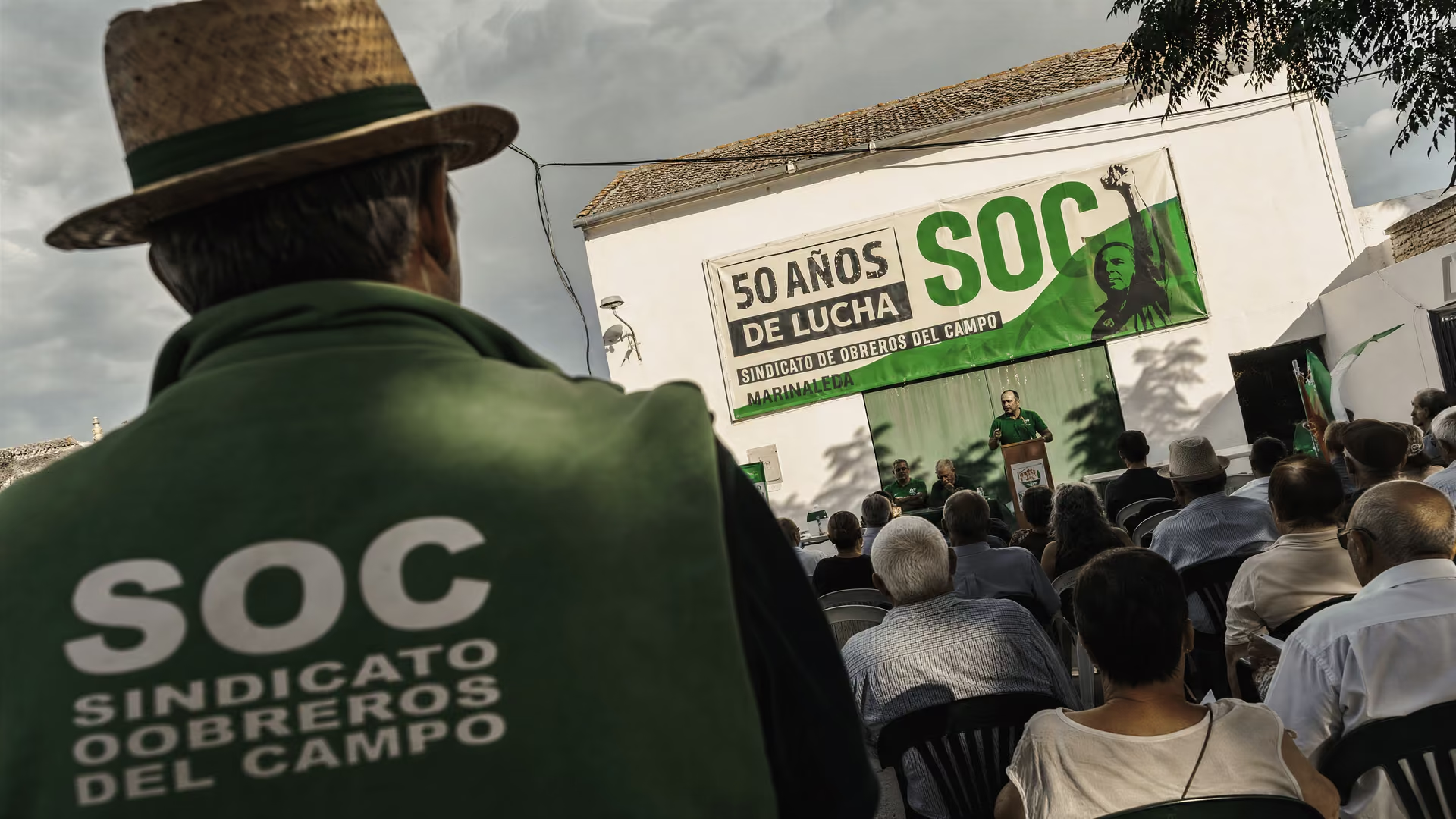
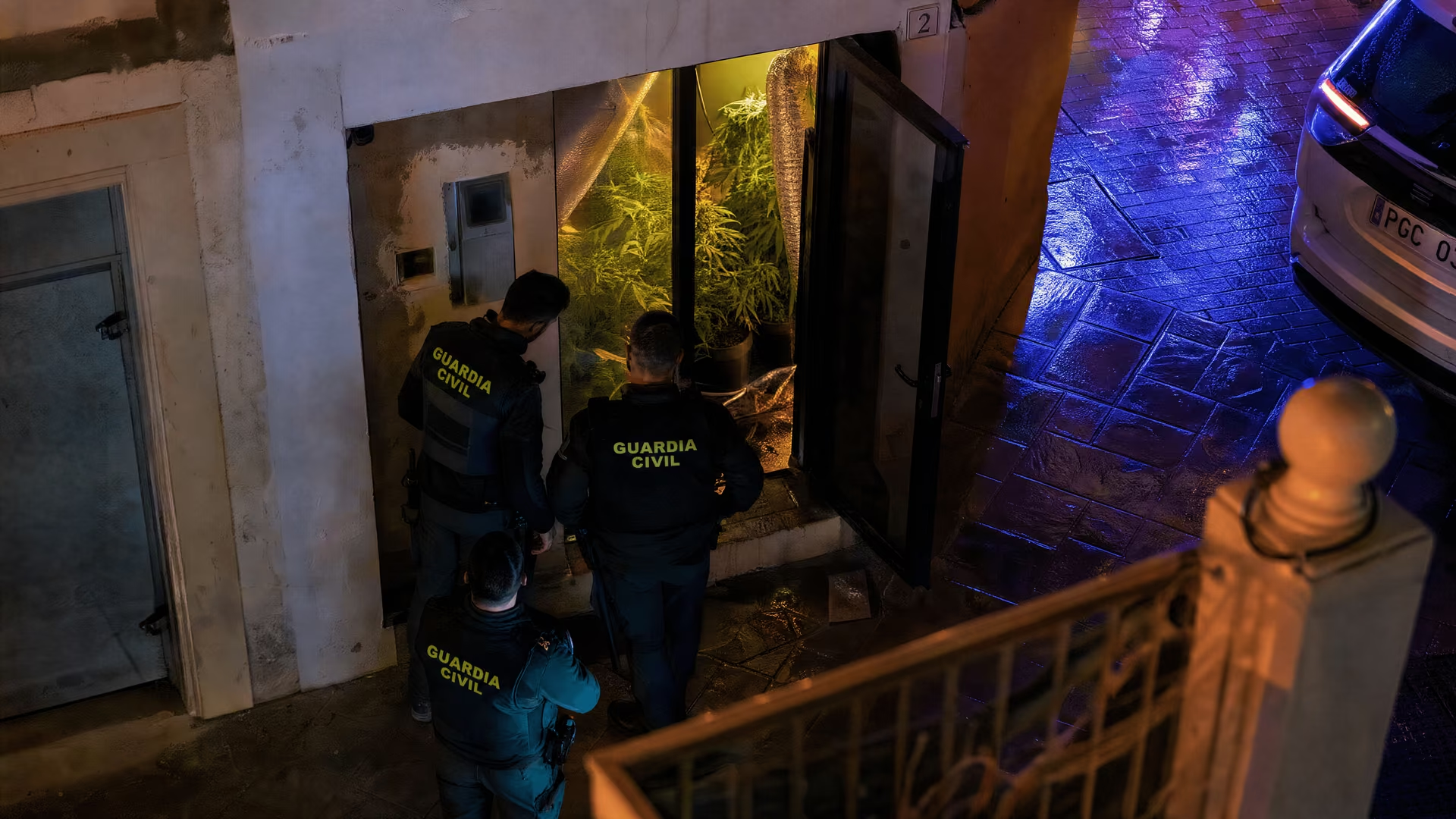
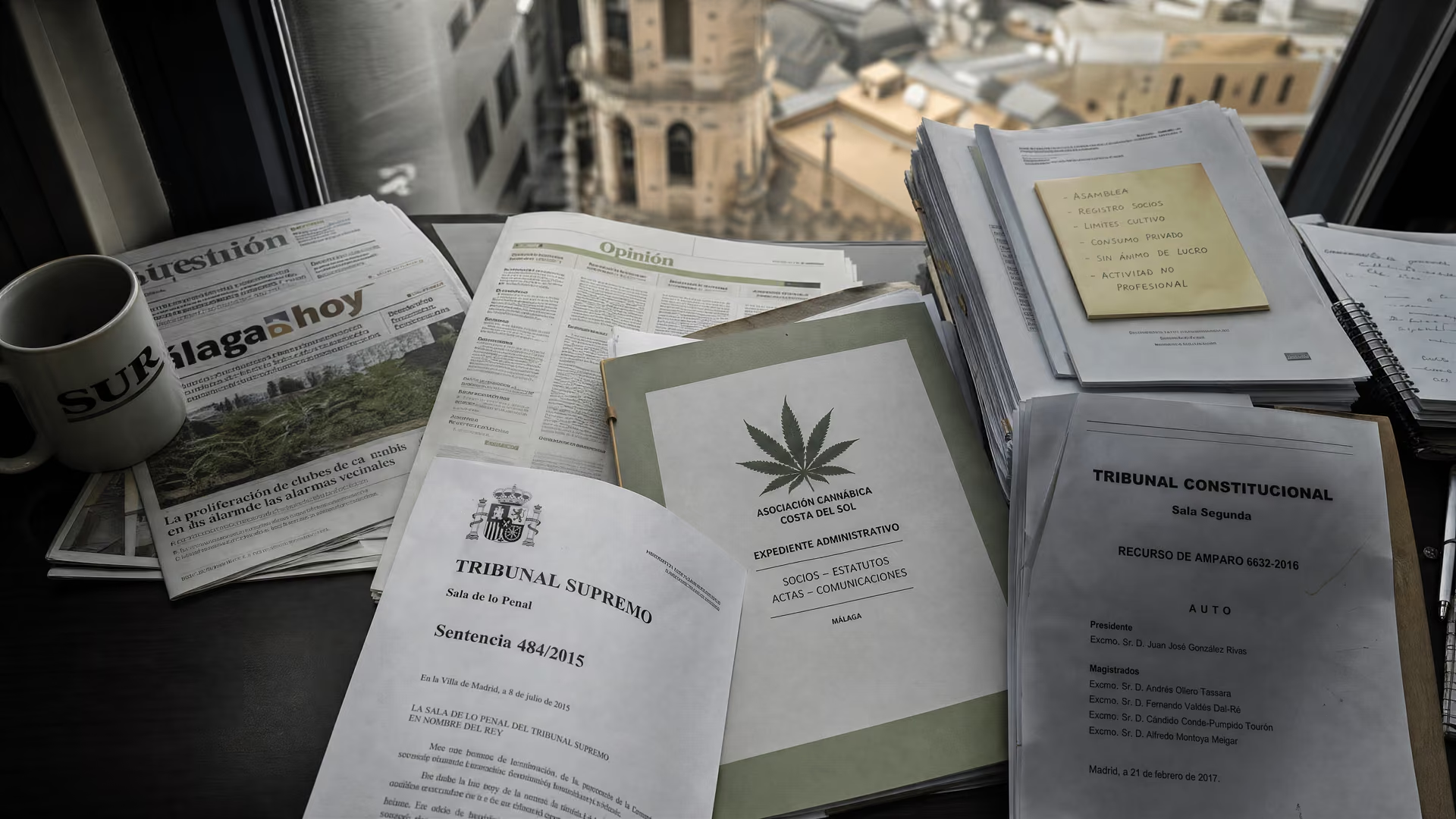
The movement’s development can be pictured through the kind of documentary record used by the researchers:

From the 1983 Penal Code reform to shared-consumption doctrine
The roots of the club model lie in changes to Spain’s criminal-law framework during the 1980s. The 1983 reform of the Spanish Penal Code distinguished cannabis from substances regarded as more serious and left consumption outside criminal punishment, while continuing to punish trafficking and the facilitation of use. That combination created a space in which personal consumption was treated differently from supply, but the boundary between the two was not always clear.
Associations such as ARSEC in Barcelona used collective cultivation as a way of testing that uncertainty. The 1990s produced contradictory convictions and acquittals, but courts gradually developed the doctrine of shared consumption. In broad terms, that doctrine distinguished trafficking from non-profit provision among a closed group of people who already consumed. It did not amount to a simple statutory authorisation for clubs, and its application depended heavily on the facts of individual cases.
The principal milestones in that process were:
This chronology explains why the movement was vulnerable from the outset. Its existence depended on the interpretation of general criminal-law principles, the factual boundaries of shared consumption and the willingness of different authorities to tolerate or engage with associations. It was never simply the result of one national law establishing a regulated chain of retail outlets.
Catalonia and the Basque Country followed different routes
The study places the Basque Country and Catalonia at the centre of the movement’s expansion, but it does not treat them as identical cases. The Basque model developed over a longer period, between 2002 and 2011, with associations adapting their structures to the evolving jurisprudence. In Catalonia, especially Barcelona, growth accelerated sharply after 2012 and quickly produced a much larger number of registered associations.
The contrast can be summarised as follows:
| Dimension | Basque Country | Catalonia | Source |
|---|---|---|---|
| Main period described | 2002–2011 | From 2012, with marked growth in 2013–2014 | Study of Spain’s cannabis social-club rise and decline |
| Organisational development | Smaller groups were used to adapt to jurisprudence | Barcelona became the centre of rapid association growth | Study of Spain’s cannabis social-club rise and decline |
The Basque experience also involved a more dialoguing relationship with public institutions. According to the study, Basque institutions funded research and facilitated public debate, helping create what the authors call temporary zones of tolerance. That did not settle the national legal question, but it gave associations more room to organise and explain their model.
The movement’s own infrastructure developed alongside that institutional engagement. The Federation of Cannabis Associations, created in 2003, coordinated legal strategies and encouraged self-regulation. The 2011 ENCOD code then formalised principles that activists wanted European clubs to follow. The principles described in the source included:
- A non-profit association structure rather than a commercial retail model.
- Collective self-cultivation connected to a closed membership group.
- A distinction between shared consumption and trafficking.
- Harm-reduction principles as part of the movement’s proposed self-regulation.
- Organisational practices intended to respond to court decisions and their limits.
Catalonia’s expansion exposed the limits of that approach. The source states that Catalonia greatly exceeded the Basque Country in registered associations per 100,000 inhabitants. The rapid increase made the clubs more visible to local authorities, prosecutors and courts, while also intensifying the question of whether a model developed for small, closed groups could support hundreds of associations without becoming indistinguishable from commercial supply.
Why Spain’s courts narrowed the social-club space
The central finding is not that Spanish courts suddenly changed one clear rule. Rather, the study describes a process in which activists, autonomous-community authorities, prosecutors and judges jointly produced an ambiguous legal environment. That environment allowed associations to grow for a period, but it also left the model exposed to later judicial reinterpretation.
The decisive issue was the distance between the original doctrine of shared consumption and the scale and operation of some later associations. A private group cultivating collectively for its members was presented differently from an organisation that appeared to facilitate access for a broad or changing public. Spain’s Supreme Court progressively rejected interpretations that could extend the shared-consumption reasoning too far, while the Constitutional Court also contributed to closing the legal space.
The distinction at the heart of the case can be stated plainly:
The legal space was created through contested governance and was later progressively closed by Spain’s highest courts.
Summary of the University of Granada study’s central finding
Several boundaries therefore shaped the fate of the model:
- Consumption was not treated in the same way as trafficking under the 1983 reform.
- The shared-consumption doctrine concerned a closed group rather than an open public market.
- Non-profit organisation was a defining principle of the club model.
- The study describes collective self-cultivation as an alternative to the illicit market, not as a general retail authorisation.
- Later court decisions narrowed the interpretations on which the associations had relied.
This is why the word decline needs care. The supplied research does not establish a single date on which all Spanish clubs ceased operating, nor does it give a current national count. It documents the progressive closure of the legal and political space that had made the expansion possible.
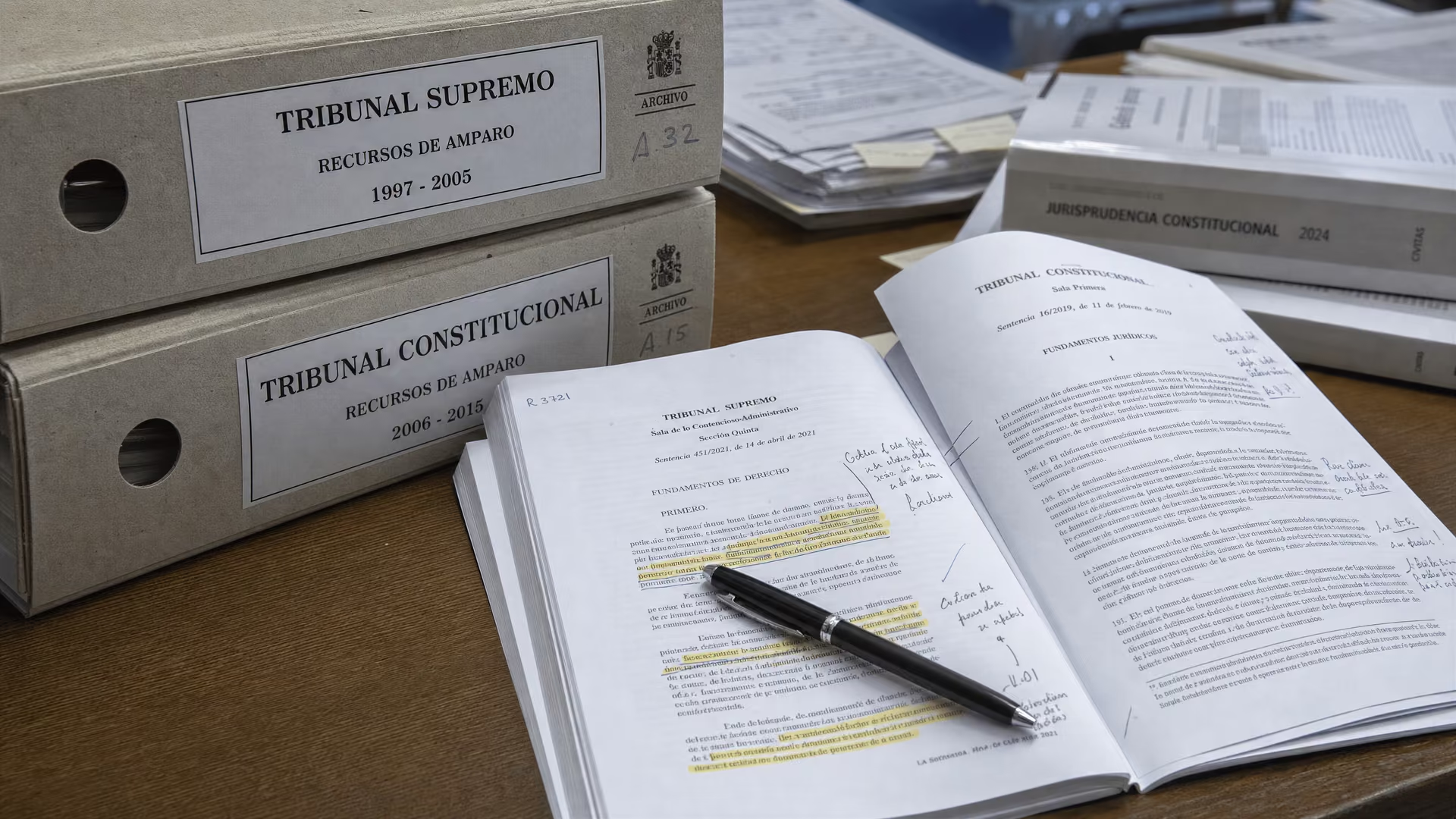
The judicial record examined by the researchers is represented by a distinctly legal archive:
What the history means for Málaga
For Málaga residents and international visitors, the most immediate lesson is the difference between a social club and a public-facing cannabis business. In Málaga, as elsewhere in Spain, a cannabis social club is a private, members-only, non-profit association under the Spanish framework described above. It is not a shop or dispensary, it is not open to the public, and travelling to Málaga or another part of Spain does not itself create a right of access.
Membership is a private legal matter decided by each association. The history of the movement does not establish automatic eligibility for visitors, and the study does not provide a current count for Málaga city or Málaga province. It would therefore be misleading to infer a local number or a local legal outcome from the national figures alone.
Separate enforcement reports from Spain illustrate why the boundaries matter. A report on arrests in Dénia described allegations that an association had been used to sell to non-members, including foreign visitors. Another report on a club in Carmona described a precautionary closure after authorities identified serious deficiencies and cannabis whose origin was not accredited. These are reports about specific alleged conduct, not evidence that every association follows the same pattern, but they show the difference between the private model described by the researchers and activity treated by authorities as commercial or unlawful.
The Dénia case was reported as an alleged operation involving six arrests in a report on the dismantling of a cannabis club. The Carmona closure was separately described in a report on the club’s alleged deficiencies and unaccredited cannabis. Neither report supplies evidence about a specific Málaga association.
The practical limits for readers in Málaga are therefore clear:
- The national peak of 800 to 1,000 associations belongs to the late 2010s, not necessarily to the present.
- The University of Granada study does not provide a current Málaga or Málaga-province club count.
- The court-led decline concerns the legal space supporting the model; it does not supply a simple nationwide closure total.
- Reports of alleged commercial activity by individual associations should not be generalised to every private club.
The legacy of Spain’s contested club model
The rise of Spain’s cannabis social clubs was the product of a particular combination: a Penal Code distinction between consumption and trafficking, unresolved questions about collective self-cultivation, activist efforts to test the law, regional variation and a period of institutional tolerance. The decline came when the same arrangement was subjected to stronger judicial scrutiny and the Supreme Court and Constitutional Court rejected broader readings of the legal grey area.
That history is especially relevant in a decentralised country. Regional authorities could influence the political climate, support research or open public debate, but they could not permanently settle the criminal-law boundaries applied by Spain’s national courts. The Basque experience showed how dialogue and self-regulation could create room for associations. Catalonia’s rapid expansion showed how quickly that room could become contested.
The study also leaves a broader policy question. If the original clubs were created as a community-based alternative to the illicit market, then the movement’s legal vulnerability came partly from the absence of a clear, uniform statutory framework. Associations, regional governments, prosecutors and courts were required to define the boundaries through practice and litigation. That made the model flexible enough to expand, but unstable enough to contract.
For readers seeking a straightforward answer about the model, the available facts support the following:
Questions about Spain’s cannabis social-club history
Were cannabis social clubs created by a single Spanish legalisation law?
No. The study describes their development as a contested process built around criminal-law distinctions, court doctrine, activist strategies and decentralised governance rather than a straightforward national law establishing retail clubs.
How many clubs did Spain have?
The study says Spain reached between 800 and 1,000 clubs by the late 2010s. It does not provide a current nationwide total after the legal space was progressively narrowed.
What made a social club different from a shop?
The model described by the study was private, members-only, non-profit and based on collective self-cultivation for a closed group. It was not an open public retail system.
Can being a visitor to Málaga provide club access?
No general tourist access follows from being in Málaga or Spain. Membership is a private matter decided by each association, and the clubs are not open to the public as shops or dispensaries.
Why did the movement decline?
Spain’s Supreme Court and Constitutional Court progressively closed the legal space created by earlier interpretations of shared consumption and collective self-cultivation. The research describes a legal and institutional decline, not a single nationwide closure date.
Spain’s cannabis social-club story is therefore best understood as a cycle of experimentation, expansion and judicial restriction. For Málaga, its significance lies less in importing a national club count than in understanding the limits of the private association model and the continuing importance of Spanish criminal-law boundaries.
Spain’s cannabis social-club movement grew because activists and regional institutions found room within an uncertain legal framework, then declined as Spain’s highest courts narrowed that room. The experience remains relevant in Málaga because it shows why private membership, non-profit organisation and closed-group principles cannot be treated as equivalent to public retail access. It also shows why local assumptions should be tested against Spain’s national criminal-law framework rather than against the movement’s peak years.
Sources
- Reducir daños del basuco exige enfrentar también la violencia (canamo.net)
- Irlanda busca destrabar el cáñamo industrial tras cultivar solo 11 hectáreas (canamo.net)
- Medio siglo de rebeldía jornalera en Andalucía: el SOC celebra este mes su 50 aniversario en Marinaleda (eldiario.es)
- La operación salida de agosto deja atrás a muchas personas mayores: "Es la época más dura para su soledad" (eldiario.es)
- Metro de Málaga crece casi el 3% y roza los 10 millones de viajeros en el primer semestre (diariosur.es)
- Fin de semana de contrastes: taró el sábado y terral el domingo en Málaga (diariosur.es)
- Seis detenidos por usar un club cannábico como tapadera en Dénia para vender droga a extranjeros (lamarina.eldiario.es)
- Precintada una asociación cannábica en Corralejo tras incumplir una orden de clausura temporal (radioinsular.es)
- La Policía Nacional detiene al responsable de una asociación cannábica por un delito de tráfico de drogas (antenadecanarias.com)
- Clausuran un club de cannabis en Carmona por graves deficiencias y droga sin origen acreditado (diarioavanza.es)