Spain’s Sindicato de Obreros del Campo marks 50 years in Marinaleda, tracing Andalusia’s farmworkers’ struggle, autonomy and unfinished demands.

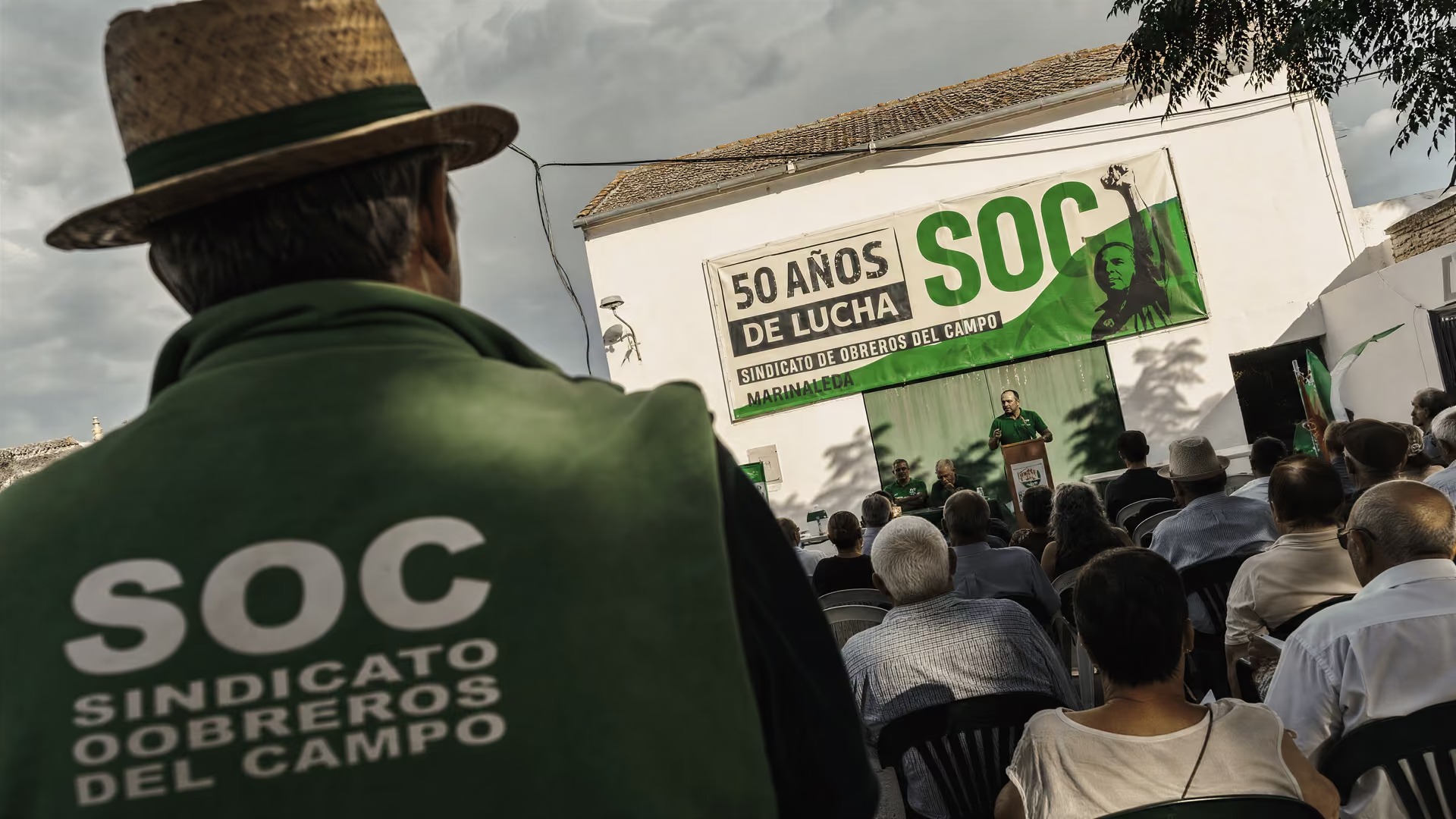
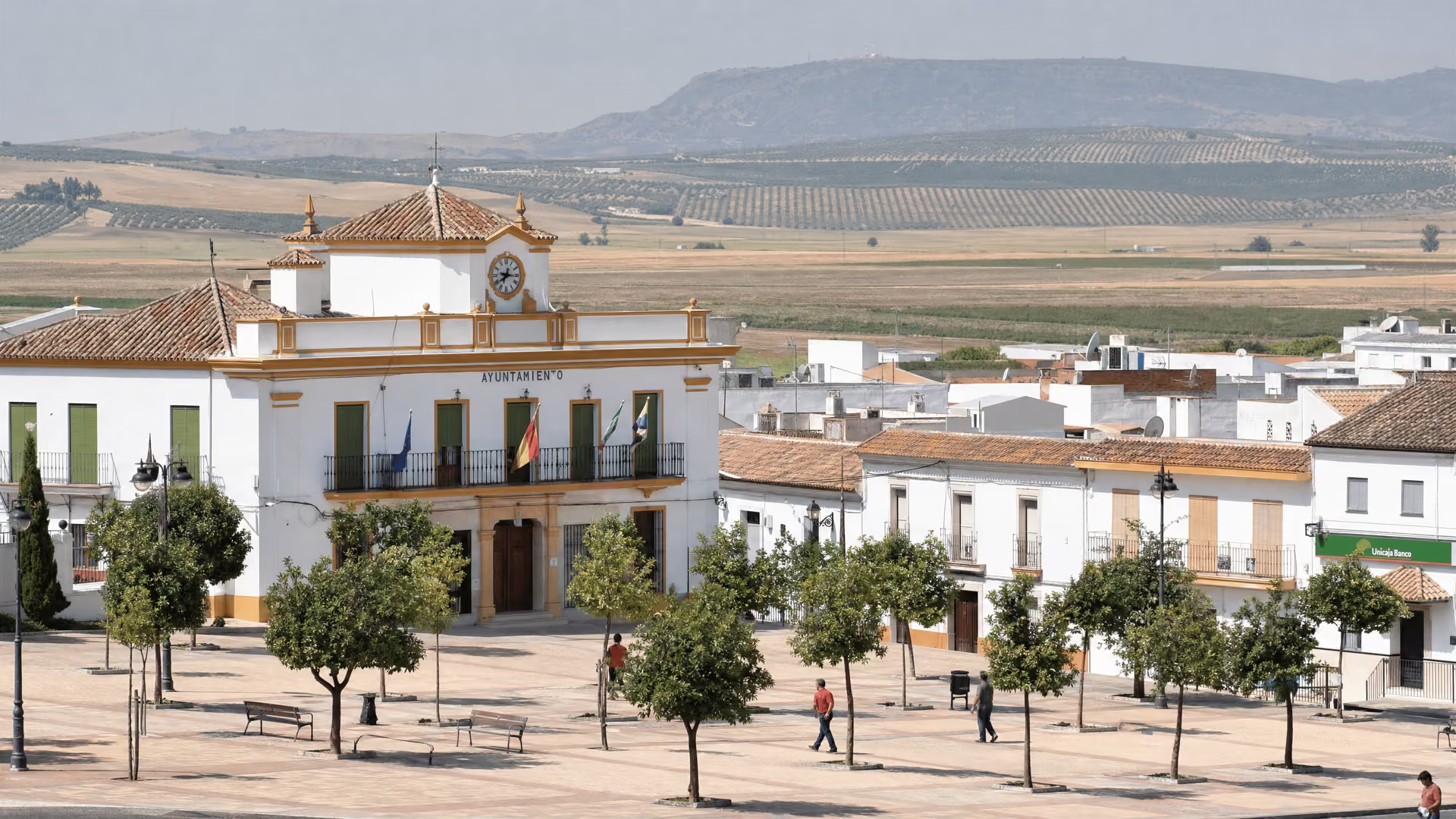
Spain’s Sindicato de Obreros del Campo (SOC) will mark its 50th anniversary on 28 and 29 August 2026 in Marinaleda, revisiting the farmworkers’ movement that became the first union to be legalised in Andalusia and helped reshape the region’s rural politics. The anniversary comes half a century after organisers formed the commission that prepared the union’s founding assembly during the final years of Franco’s dictatorship. For readers in Málaga and across Spain, the commemoration is a reminder that Andalusian social history was also built through rural struggles over dignity, representation and self-government, not only through institutions in the region’s larger cities.
Marinaleda prepares to mark a half-century of the SOC
The SOC’s anniversary gathering will bring together memories of a movement whose origins lie in the political uncertainty and economic hardship of the Spanish transition. The union was formally preceded by a commission created in Antequera on 1 August 1976, followed soon afterwards by the constituent assembly in Morón de la Frontera. The organisation’s history, as recounted in the elDiario.es profile of the anniversary, is told through the recollections of people who helped establish it and those who continue its work.
The event will take place in Marinaleda on 28 and 29 August. Paco Casero, the SOC’s first general secretary, is expected to attend. Today he presides over the Savia Foundation, but his assessment of the union’s place in Andalusian history remains direct: he argues that the region’s recent history cannot be written without the SOC because it combined a demand for dignity and rights in the countryside with a claim for Andalusian self-government.
The anniversary’s essential figures are:
The organisation’s half-century can be followed through three turning points:
A union born in the final years of Francoism
The founding story begins with restrictions as much as with formal organisation. Paco Casero recalls that the first meetings were held in a convent because there was no other suitable place. The organisers met around the church and took security precautions, a detail that places the creation of the SOC within the repressive conditions of the final years of Franco’s rule.
It was in a convent, because in those days we held meetings around the church; there was nowhere else, and we always took security measures.
Paco Casero, recalling the SOC’s early meetings
The account of the SOC’s founding identifies the organisation as the first union to be legalised in Andalusia. Its early leadership included Casero, who became the first general secretary, and Gonzalo Sánchez, who presided over the organisation. The worker priest Diamantino García, Diego Cañamero and Pepi Conde were also among the figures who helped build the union.
Several elements define the circumstances in which the SOC emerged:
- A commission was formed in Antequera on 1 August 1976 to prepare the union’s constituent assembly.
- The assembly process continued shortly afterwards in Morón de la Frontera.
- Meetings took place in a convent and around the church because organisers lacked another safe venue.
- The union linked workplace demands in the countryside with a wider claim for Andalusian self-government.
- The organisation later became a recognised part of the rural movement within the Sindicato Andaluz de Trabajadores, or SAT.
That combination of labour organisation and regional political identity was central to the SOC’s early public presence. Casero recalls that the Andalusian flag appeared consistently in the movement’s marches and mobilisations. He also points to the union’s support for Rafael Escudero’s hunger strike as part of the political environment in which it operated.
The people who carried the movement into the countryside
The anniversary is being remembered through several generations of organisers. Casero speaks as a founding secretary who sees the SOC as part of Andalusia’s collective history. Pepi Conde recalls the difficulties of organising as a woman in a male-dominated rural world. Diego Cañamero describes the unemployment and land concentration that drove young farmworkers into mobilisation, while Óscar Reina explains why the SAT still regards the SOC as a source of political and social energy.
Their roles and perspectives can be set out as follows:
| Person or group | Role in the SOC story | What the reporting records | Source |
|---|---|---|---|
| Paco Casero and Gonzalo Sánchez | Early leadership | Casero became the first general secretary and Sánchez initially presided over the organisation. | elDiario.es anniversary report |
| Pepi Conde | Member of the first executive | She helped organise women farmworkers and challenged the traditional role assigned to women in rural communities. | elDiario.es anniversary report |
| Diego Cañamero and Óscar Reina | Early activist and current SAT spokesperson | Their accounts connect the SOC’s original rural demands with present-day labour insecurity and migrant workers’ rights. | elDiario.es anniversary report |
Pepi Conde and the struggle for recognition
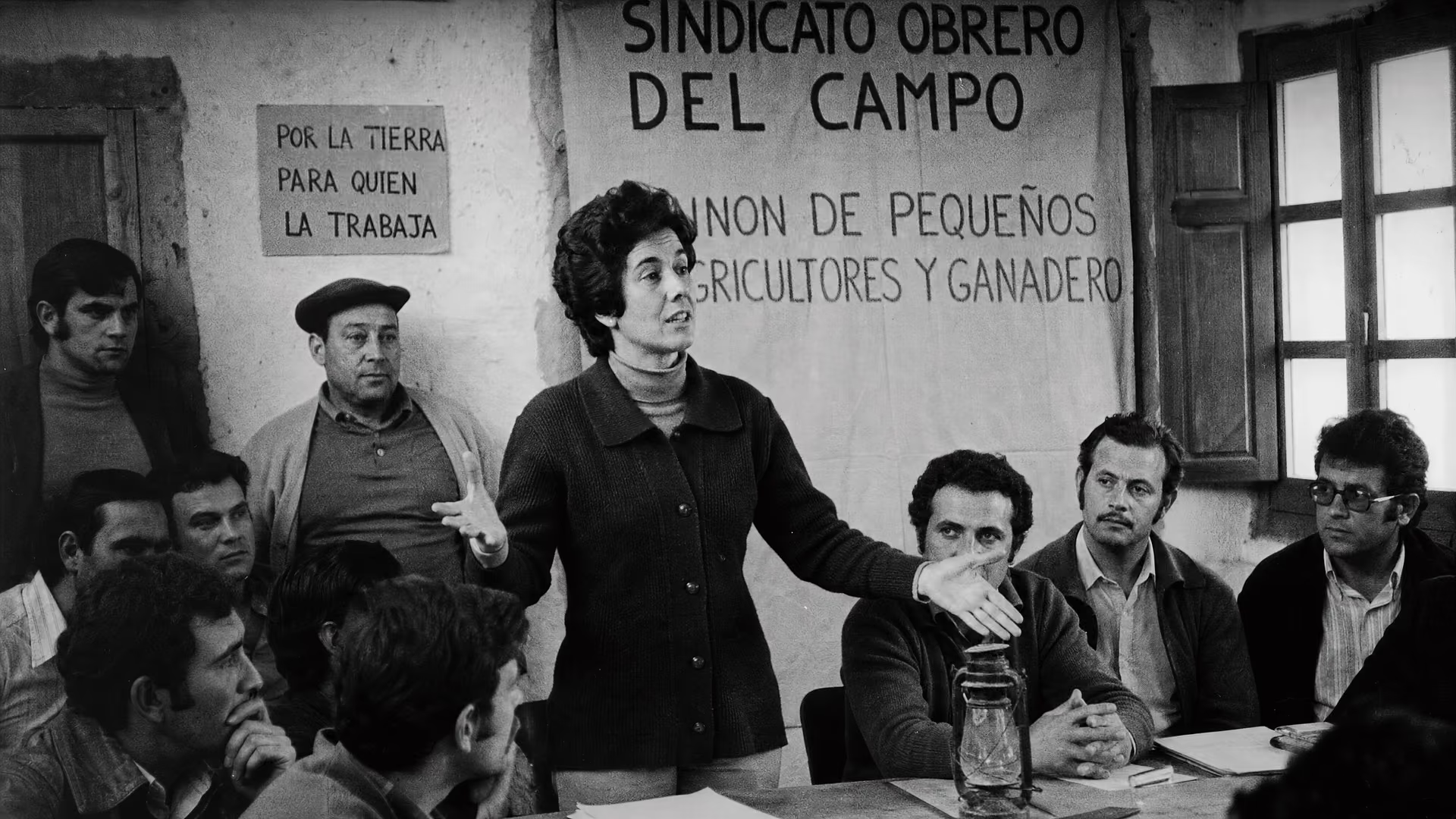
Conde’s account adds a gendered dimension to the union’s early history. She began working in the fields as a child because her father’s wages could not support the family. In the year the SOC was founded, she joined its first executive after already participating in the Comisiones Jornaleras, the coordinating body that preceded the union.
Her activism brought repeated pressure. During the final years of Francoism, the Guardia Civil took her to the barracks almost daily even though she was still a minor. She also faced hostility from women and men in her community as she entered public spaces that were generally reserved for men, including taverns where she delivered political speeches.
Conde remembers one early labour demand in particular: agricultural work records for women. Many women worked too briefly to qualify for the documentation, and she says almost 300 women went on strike to demand what they regarded as a basic right. She also presented an early paper on women in the countryside during the union’s formation.
From Lebrija’s organising to Andalusian autonomy
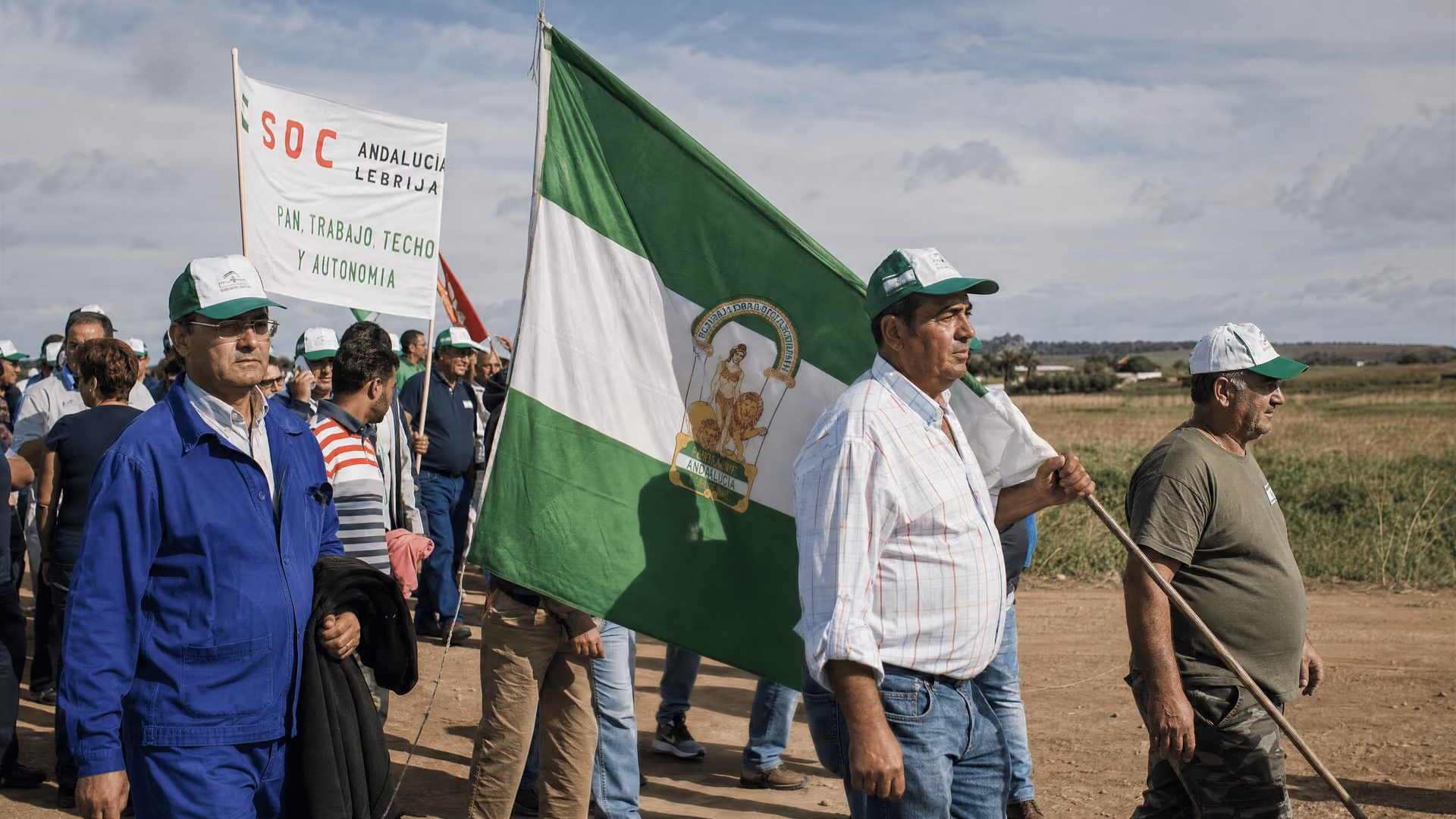
The SOC did not remain confined to the towns where its founding meetings took place. Casero singles out Lebrija as a decisive early base, calling it a stronghold of rupture and saying that the movement owed much to the people there. From that starting point, the project reached other municipalities across the Sierra Sur of Seville, the Campiña and the Sierra de Cádiz.
This spread gave the union a regional character at a time when Andalusia was also asserting its political identity. The movement’s marches carried the Andalusian flag, and its members supported actions that linked social demands with the question of self-government. Casero therefore sees the SOC not simply as a workplace organisation but as part of the political history that helped advance Andalusia’s autonomy.
The connection between land, work and regional identity was rooted in the conditions described by Cañamero. When he began mobilising, he says the countryside was dominated by a narrow range of crops, including wheat, sunflower, olives and some sugar beet. Long periods of unemployment left town squares full of people waiting for a foreman to offer a day’s work. The final years of Francoism and the transition added a political charge to that economic frustration.
The SOC arose from a need: there was a great deal of unemployment, while 50% of the land was in the hands of 2% of landowners.
Diego Cañamero, describing the union’s origins
Cañamero later became mayor of El Coronil and describes the SOC today as the foundation of the rural movement within the SAT. He says the countryside has diversified and now provides work throughout the year in ways that were not possible in the union’s early period. But that change has not removed the need for organisation; it has altered the workers and the problems being brought to it.
Women’s labour became one of the SOC’s first tests
Conde’s experience shows that the SOC’s internal and external struggles were connected. The union challenged the conditions of agricultural work while also forcing a debate about who could speak, organise and lead within rural communities. Her participation in the first executive placed a woman at the centre of an organisation operating in a setting she describes as deeply shaped by machismo.
The main markers of Conde’s path into the movement are:
The agricultural work record, or cartilla agrícola, mattered because women who worked for only short periods often stopped accumulating the documentation associated with their labour. Conde’s account presents the strike as both a practical campaign and a challenge to the assumption that women’s work in the fields could remain administratively invisible.
She recalls insults on the way home and men questioning her in openly degrading terms. Yet she also remembers support from her family and respect from male colleagues who recognised her work as a union organiser. Her decision to speak in taverns and present a paper on women in the countryside marked a move into spaces and debates from which women had commonly been excluded.
That history complicates any simple account of the SOC as a unified movement. Its members were confronting unequal land ownership, unemployment and political repression, while women inside the organisation were also contesting the gender hierarchy of the communities in which the union operated.
The unfinished questions facing the SOC and the SAT
The anniversary is not being presented only as a celebration of past victories. Casero argues that institutions still owe recognition to the countryside, both to the rural world of the past and to the one that exists today. He points to Andalusia’s position as a European reference in ecological agriculture but says the SOC’s contribution has never received adequate institutional acknowledgement.
Casero says he was offered the Medalla de Andalucía twice and rejected it because of what he regarded as the continued omission of the SOC’s struggle. His criticism is aimed at the gap between the social reality of rural Andalusia and the recognition granted by public institutions.
The movement’s present-day pressures are reflected in the figures cited by its representatives:
A changing workforce and a wider form of precariousness
Cañamero says the SOC now deals mainly with thousands of workers who have arrived from other countries, particularly in the greenhouses of Almería and Huelva. He rejects the claim that local people simply do not want agricultural work, arguing instead that employers cannot expect 50,000 people to be available from one day to the next while leaving other jobs in construction or care work.
He also says collective agreements are still not being fulfilled and that agricultural workers face some of the worst labour conditions. The reductions he cites in retirement and sick-leave payments illustrate why the union’s original concerns about dignity and security remain relevant even though the profile of the workforce has changed.
Óscar Reina, the SAT spokesperson, places the same argument beyond agriculture. He says the SOC remains an essential source for the organisation because economic systems continue to produce injustice. In his view, short contracts and work arranged by the day or the hour now affect health care, education, hospitality and dependency care as well as the fields.
Reina describes this process as the spread of farmworker-style insecurity across the wider labour market. He argues that the lesson of the older struggles is not nostalgia but organisation: reaching workplaces and people who are rarely heard, including migrants and others left at the margins of the system.
The anniversary therefore carries two messages at once. It records a movement that helped change the rural balance of power and contributed to Andalusian political mobilisation. It also insists that the conditions that produced the SOC have not disappeared; they have been redistributed across a more diverse and precarious workforce.
The principal points from the anniversary story are:
When the SOC gathers in Marinaleda, it will be looking back to a commission formed in 1976, but not to a closed chapter. The recollections of Paco Casero, Pepi Conde, Diego Cañamero and Óscar Reina present the organisation as part of Spain’s Andalusian history and as a continuing response to unequal work, weak institutional recognition and the changing shape of rural precariousness. Fifty years on, the anniversary’s central question is not only what the SOC achieved, but why its original demands still find new forms across the region.
Sources
- Reducir daños del basuco exige enfrentar también la violencia (canamo.net)
- Irlanda busca destrabar el cáñamo industrial tras cultivar solo 11 hectáreas (canamo.net)
- Medio siglo de rebeldía jornalera en Andalucía: el SOC celebra este mes su 50 aniversario en Marinaleda (eldiario.es)
- La operación salida de agosto deja atrás a muchas personas mayores: "Es la época más dura para su soledad" (eldiario.es)
- Metro de Málaga crece casi el 3% y roza los 10 millones de viajeros en el primer semestre (diariosur.es)
- Fin de semana de contrastes: taró el sábado y terral el domingo en Málaga (diariosur.es)